Tekstit

Näytetään tunnisteella carbon stock merkityt tekstit.

Forest Carbon and Forest Carbon flux in Kainuu region

Kuva
Picture 1. The forests in Kainuu region are typically coniferous forests, under practical silviculture Kainuu region is geographically a central or central-eastern region in Finland. It is forested, scarcely populated region. Forestry is an important source of livelihood in the region. The amount of solid cubic meters in 2011 in Kainuu forests was 163 million cubic meters and 172 million cubic meters in 2016. Correspondingly, the area of forest hectares was 1.930 million hectares and 1.928 million hectares in 2011 and 2016, respectively (NFI 11 and NFI 12 inventories). With average Carbon Multiplier CM = 0.35314 tn C/m3 the total Carbon stock (stems, branches, foliage, roots) in Kainuu was 57.6 million tons in 2011 and 60.7 million tons in 2016. Forest carbon number is calculated by dividing the total carbon stock (c, tn C) at certain time point (t, years) with the forest land area (fl, hectares) at certain time point, for the selected area. (1)     fc(t) = c(t) / fl...
Carbon stock in and Carbon fluxes at mineral soil arable lands in Finland

Kuva
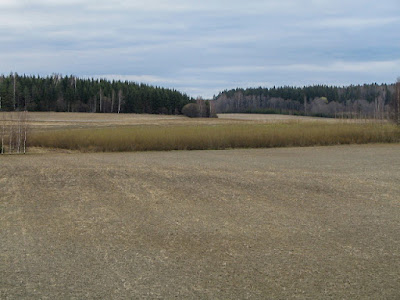
Carbon in agricultural fields belongs to the most topical research sectors for climate change in 2020s. Carbon husbandry is searching for new methods how to increase the Carbon stock in the soil. Also perennial crops and agroforestry methods have become more topical, like possibility of willow husbandry in new era farms (Picture 1).  Picture 1. Annual and perennial crop blocks in the agriculture Carbon in agricultural fields, in arable lands has been measured by the Natural Resource Institute Finland (Luke) in a comparative manner, in several hundreds sample plots, by repeating four times, since 1987 (ref 1). The basic measurements have been done for the content of elementary Carbon in dry soil (g C/kg). The measurements cover three soil classes: mineral soil, mull soil and peat soil. The classification is based on the share of dry weight organic (humus) soil in the total soil dry weight. In mineral soil the organic share is less than 20 per cent. In mull soil the share is between ...

Forest Carbon number and Forest Carbon flux, per forest hectare, at national level, in Finland since 1921

Kuva
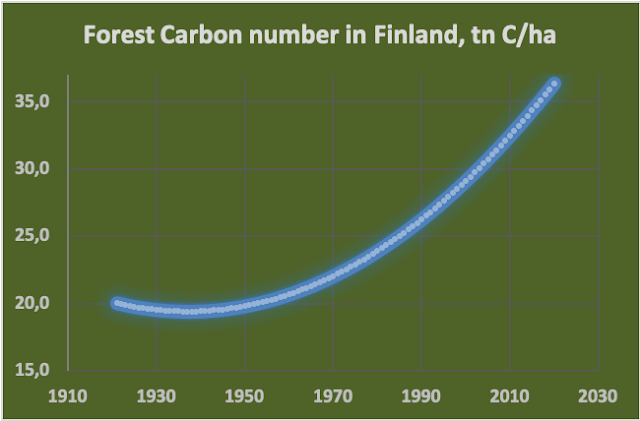
Forest carbon number for a special year tells how many tons of elementary Carbon there is per forest hectare. The Carbon is stored in the trees, including the solid stems, the branches, the foliage and the roots. Forest carbon number can be calculated at various categories level like at farm forest level, at regional forests level, at national forests level and at global forests level. Forest carbon number (fc) is calculated by dividing the total carbon stock (c, tn C) at certain time point (t, years) by the forest land area (fl, hectares) over the selected category. (1)      fc(t) = c(t) / fl(t) At Finnish national level the Carbon stock (c) equation is (2)     c(t) = 0.06460  * t^2 - 250.40 * t + 243136 Consequently, the forest land (fl) equation is (3)     fl(t) = -0.006073 * t + 38.46 The development of forest carbon number (fc, equation 1) for Finnish forests is shown in Figure 1. Figure 1. Development of Forest car...

Total Carbon stock, and trees Carbon source or sink flux in Finnish forests since 1921

Kuva
The content of elementary Carbon in the dry biomass is quite constant of 50 per cent, of the dry weight. In simplified calculations this percentage can be used for the dry biomass of trees, for the dry biomass of grasses and cereals as well as the for the young humus in the soil. The coefficient for trees, Carbon multiplier (CM) for calculations of Carbon from solid cubic meters, can be calculated in a similar manner as the  calculation of dry biomass multiplier . Picture 1. Abundant Carbon stock in the Scots pine forest, Kuusamo Also in the total forest growing Carbon stock, it is logical to sum the stems, the branches including the foliage, and the roots. Mathematically the solid cubic meters in the stems (s, cubic meters) can be converted into total Carbon stock (c, tons C) with a coefficient or carbon multiplier (CM). (1)     c = CM * s Calculated as average from the Finnish forest inventories VMI 11 and VMI 12 the Carbon Multiplier is (2)    ...

Solid cubic meters of forest trees and their annual growth in Finland since 1921

Kuva
At national level the most remarkable above ground Carbon stock in Finland is in the forests. The most common basic measurement for the forests, is the amount of above ground solid cubic meters in the trees. It is normally measured for the stems only. The data correlates strongly with the total dry biomass in the trees (stems, branches, foliage, stumps and roots). Further, the solid cubic meters data correlates strongly with the amount of elementary Carbon in the trees (stems, branches, foliage, stumps and roots). Photo 1. Boreal forests are a remarkable Carbon stock in Finland. The changes in the amount of solid cubic meters in the trees indicate the changes in the Carbon stock. Positive change tells about the Carbon sink flux into the forests. Negative change tells about the Carbon source flux (or Carbon emissions flux) from the forests.  The regular inventory of forest trees, for their solid cubic meters, has been done in Finland since 1921 (Figure 1). The latest National Fore...